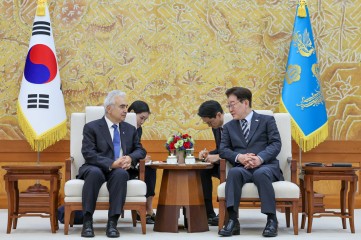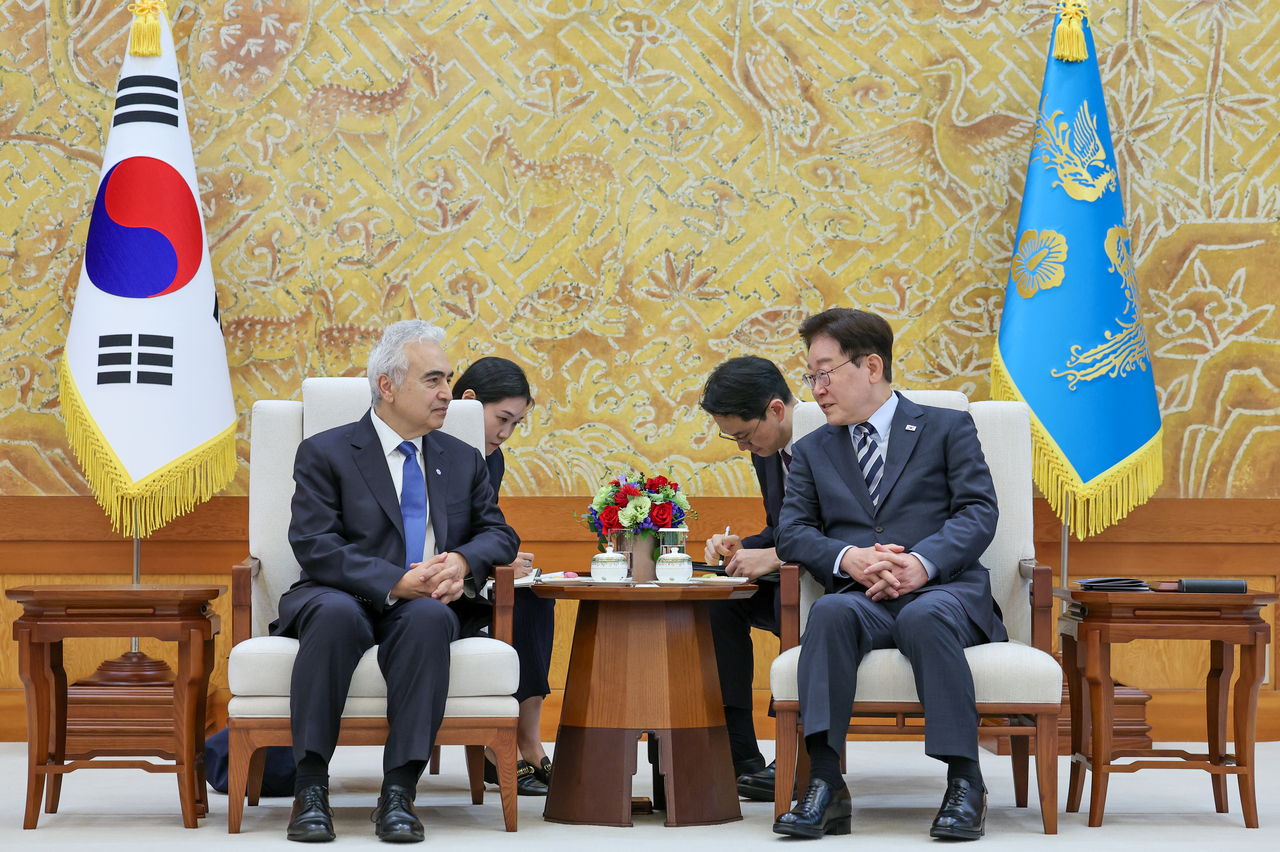
President Lee Jae Myung met International Energy Agency chief Fatih Birol on Thursday to discuss strengthening Asia-Pacific energy security as the Hormuz crisis exposes the region’s vulnerability to supply shocks.
The meeting was arranged in part to follow up on Lee’s proposal, made at the Group of Seven summit in June, to strengthen the resilience of energy supply chains across the Asia-Pacific region, according to the presidential office in Seoul.
Lee and Birol were expected to have an in-depth exchange of views on the future direction of new energy security cooperation in the region, Cheong Wa Dae added.
At the G7 summit, Lee proposed closer cooperation among energy-importing countries in the region, underscoring that the conflict in the Middle East had exposed the Asia-Pacific area’s particular vulnerability to energy supply disruptions.
The initiative calls for countries to move beyond national-level responses and pursue practical cooperation, including information sharing, early-warning mechanisms, emergency coordination and measures to stabilize supplies of crude oil and petroleum products.
Seoul seeks to work with the IEA and key partner countries to develop concrete forms of regional cooperation, while providing support for the IEA’s Singapore Regional Cooperation Center to serve as a hub for energy security cooperation in Asia.
During the meeting, Lee and Birol were also expected to discuss developments in global energy markets and industries amid the energy crisis aggravated by the conflict in the Middle East and growing climate risks underscored by devastating floods in Nepal, according to Cheong Wa Dae.
Birol has played a central role in coordinating the international response to the energy crisis triggered by the war with Iran, which began on Feb. 28 with joint strikes by the United States and Israel and has effectively blockaded the Strait of Hormuz, a vital waterway for global energy shipments.
In mid-March, the IEA’s member countries unanimously agreed to make 400 million barrels of oil from their emergency reserves available to the market, the largest coordinated stock release in the agency’s history.
According to Cheong Wa Dae, Lee and Birol were also expected to discuss ways to strengthen global energy security in what the IEA has described as an “era of electricity.”
The phrase refers to a global shift toward greater reliance on electricity, driven by electrification, artificial intelligence data centers and semiconductor manufacturing, while increasing the importance of secure supply chains for critical minerals and key grid equipment.
Birol’s visit to Korea followed stops in Beijing and Tokyo as part of his Asia tour. His trip to Korea coincided with the three-day 2026 World Climate Industry Expo, which kicked off Wednesday and has been co-hosted annually by the Korean government and the IEA since 2024.
In Tokyo on Monday, Birol met Japanese Prime Minister Sanae Takaichi to discuss the diversification of energy supply sources and Japan’s Partnership on Wide Energy and Resources Resilience Asia initiative, a regional framework aimed at strengthening energy security and supply-chain resilience across Asia, according to Japan’s Foreign Ministry.
Birol and Takaichi also agreed to deepen cooperation between Japan and the IEA amid an increasingly challenging global energy landscape.
In Beijing last week, Birol met Chinese Energy Minister Wang Hongzhi on the sidelines of the APEC Energy Ministerial Meeting, where the two exchanged views on energy issues, according to a post by Birol on X on Sept. 12.
South Korea has been a full member of the IEA since 2002 and has since deepened cooperation with the agency across energy security, policy coordination and the clean-energy transition. IEA members are required to maintain emergency oil stocks equivalent to at least 90 days of net oil imports and to be prepared to take coordinated action in the event of severe supply disruptions.
Established in 1974 in the wake of the first oil shock, the IEA initially focused on protecting oil-importing countries against supply disruptions but has since expanded its role to encompass broader energy security, clean energy transitions and climate policy.
dagyumji@heraldcorp.com